Article Contents
- 1. Velocity
- 2. Reverse brush drop
- 3. Conclusion
Word: This text is barely accessible to Bowling This Month subscribers.
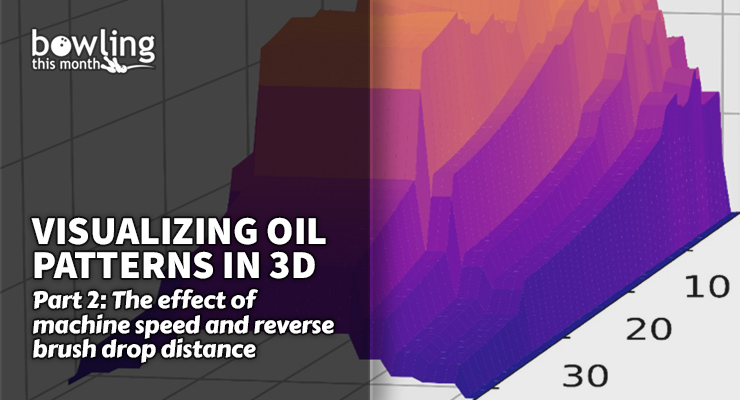
Welcome to the second article of three on this sequence, the place Kegel oil patterns are visualised in three dimensions. I might advocate studying the first article when you have not already achieved so, to get a taste for the sequence and to see the 3D graphs of some typical oil patterns.
On this article, we are going to examine the impact of two vital options of the lane machine on the form of the oil sample. The primary setting we are going to research is the pace at which the machine travels whereas making use of oil to the lane. The second setting we are going to have a look at is the gap of the reverse brush drop.
Velocity
Kegel lane machines can journey alongside the lane at six completely different speeds whereas making use of oil to the lane floor. The unit for the pace setting is inches per second, and the six speeds at which the machine can journey are 10, 14, 18, 22, 26, and 30 inches per second. The pace of the machine is significantly chargeable for controlling the front-to-back taper of the oil, which itself performs an enormous half in figuring out the general traits of the oil sample, as mentioned within the earlier article.
Usually, the lane machine will begin off at one of many slower speeds to start oiling on the ahead go. Because the machine progresses downlane towards the pins, the pace is mostly set to extend, and it isn’t unusual for 30 inches per second to be reached simply earlier than the sample size is reached. On the reverse go, oiling commences when the reverse brush drop distance is reached, at which level the buffer brush drops and resumes its contact with the lane. Sometimes, that is near the tip of the oil sample, and the lane machine will as soon as once more be touring at one of many quicker speeds. Because it approaches the foul line, the machine will are inclined to decelerate.
The motivations for this sequence of speeds are to make sure that a higher quantity of oil is positioned initially of the lane near the foul line in comparison with the tip of the sample, and that there’s a clean, gradual lower in oil with distance from the foul line. To …